big small | Delving into the Excitement of 'Math Fun': The Big and Small of Online Educational Games
In the digital age, education is continually evolving, with interactive and engaging methods becoming central to learning processes. One such method gaining traction is educational gaming, a fusion of entertainment and knowledge. A prime example is the game category 'Math Fun', which has begun making waves in online educational circles, attracting both educators and learners alike.
The term 'Math Fun' itself evokes curiosity and sparks interest among students, particularly when paired with the keyword 'big small'. At its core, this category of games is designed to make mathematical concepts enjoyable, relieving the anxiety often associated with numbers and calculations. But how does the intriguing keyword 'big small' fit into this scenario?
'Big small' encapsulates a paradoxical concept that underlies many educational strategies, presenting contrasting ideas in a playful and digestible manner. These games employ techniques that challenge players to think critically and picture the world of mathematics beyond traditional problem-solving. For instance, 'big small' could refer to understanding the magnitude of numbers, where learners compare quantities and engage in activities that ask them to identify smaller or larger numerical values.
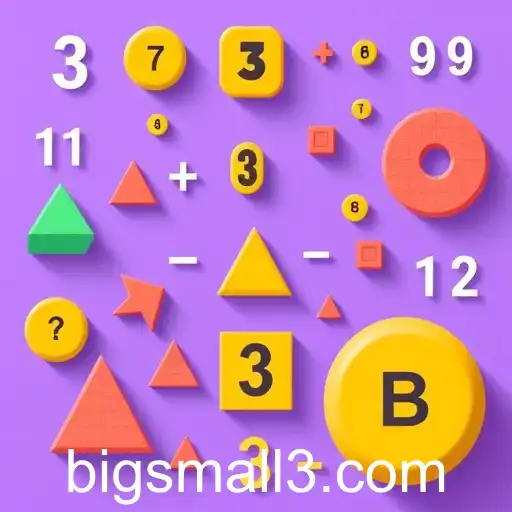
The idea is simple yet profound: teach size, volume, and value through interactive and visually stimulating games. Many of these games involve sorting, organizing, or even resizing numbers and shapes, which help children grasp basic arithmetic principles effortlessly. The juxtaposition provided by 'big small' encourages learners to recognize patterns and formations, promoting cognitive skills crucial for comprehensive mathematical understanding.
Moreover, 'Math Fun' in the context of 'big small' doesn't limit itself to just numbers. It branches into various mathematical concepts such as geometry, where big shapes and small shapes play crucial roles in understanding design and structure. Games often involve tasks like aligning big triangles with small ones or organizing big circles into patterns with smaller ones, enhancing spatial awareness and geometric insight.
These interactive games are designed to cater to different learning paces, making them accessible to a broad audience. The layering of game difficulty allows young learners to gradually progress from fundamental arithmetic to more complex concepts. By incorporating elements of competition through scoring and levels, these games create a fun and stimulating learning environment, often promoting collaborative learning among peers.
Beyond leisure, 'Math Fun' holds educational value by aligning with curriculum standards, ensuring that while students play, they're also learning necessary academic skills. The deployment of technology in learning environments has allowed teachers to use 'Math Fun' as a tool in their classrooms, reinforcing concepts taught during lessons in a manner that feels less instructional and more exploratory.
In conclusion, 'Math Fun' with the keyword 'big small' represents an innovative educational approach, blending foundational math skills with engaging gameplay. These games contribute significantly to a child's learning trajectory, making mathematics a field not to fear but to explore and enjoy. As we continue to integrate more technology into education, categories like 'Math Fun' will undeniably play vital roles in shaping the future of learning.
Gaming Innovations Revolutionize 2025
Exploring how technological advancements are shaping the gaming landscape in 2025.
The Evolution of Online Gaming in Modern Times
An in-depth look at the influence of the keyword 'big small' on English game websites in 2026.
Gaming Giants Target Older Demographics
Exploring recent trends in the gaming industry, focusing on game design innovations targeting older demographics.